
 EN
EN
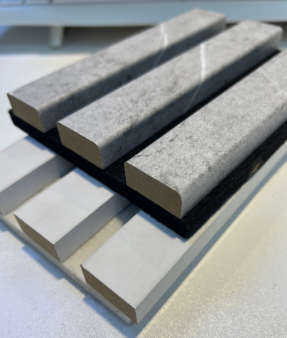
Acoustic Panel Fundamentals: How They Absorb Sound (Not Block It)
The physics of sound absorption: converting acoustic energy to heat via friction in porous materials
Acoustic panels work through absorption—not blocking. When sound waves strike the panel’s porous surface, they enter the material rather than reflecting back. Inside, the open-cell structure creates friction as air molecules vibrate against fibres, converting acoustic energy into a negligible amount of heat—typically less than 1°C—effectively dissipating the sound. The result is fewer reflections, reduced echo, and improved clarity within the space. Crucially, standard acoustic panels do not stop sound from passing through walls or ceilings; they are designed solely to manage reverberation inside a room. This distinction is essential for anyone designing a home studio, office, or living area. For example, an untreated open-plan office often has a reverberation time (RT60) exceeding 1.2 seconds—well above the recommended 0.4–0.6 seconds for workplaces—while strategic panel installation can bring it into compliance.
Key material properties—porosity, density, thickness—and their impact on the sound absorption coefficient (α)
The effectiveness of an acoustic panel is quantified by its sound absorption coefficient (α), which ranges from 0 (no absorption) to 1 (total absorption). Three core material properties directly shape α:
| Property | Effect on absorption | Typical impact |
|---|---|---|
| Porosity | More open pores allow deeper wave penetration | Higher α for mid- and high-frequency sound |
| Density | Moderate density balances airflow resistance | Too dense → reflects; too light → transmits sound |
| Thickness | Greater depth enables lower-frequency absorption | Each additional inch shifts effective absorption downward by ~100 Hz |
Most residential panels achieve a Noise Reduction Coefficient (NRC) of 0.70–0.95. A typical 2-inch, medium-density panel excels at absorbing mid-range frequencies but offers minimal control over bass—underscoring the need to match panel specifications to the room’s dominant acoustic issues.
Measurable Acoustic Benefits of Acoustic Panels in Real Indoor Spaces
Reverberation time (RT60) reduction across environments: office, home theater, and open-plan living areas
Reverberation time (RT60) measures how long sound lingers after the source stops. By absorbing excess acoustic energy, panels significantly shorten this decay. In untreated open-plan offices, RT60 often exceeds 1.2 seconds—impairing concentration and speech clarity. Properly placed panels can reduce RT60 to 0.4–0.6 seconds, aligning with ANSI/ASA S12.60 and ISO 3382-2 workplace guidelines. Home theaters see RT60 drop from ~0.8 s to around 0.3 s, sharpening dialogue and preserving dynamic range. Open-plan living areas—typically dominated by hard surfaces—can improve from 1.5 s to 0.7 s, yielding measurable gains in usability and comfort. Field data consistently shows 40–60% RT60 reduction across these settings.
Improved speech intelligibility (STI) and subjective acoustic comfort—validated by user studies and field measurements
Speech Transmission Index (STI) objectively measures how clearly spoken words are understood. Untreated, highly reverberant rooms often register STI values below 0.45—classified as “poor.” After acoustic treatment, STI rises above 0.70 (“good”) in conference rooms and classrooms, per independent field trials conducted under ISO 3382-1 protocols. User studies further confirm that occupants report a 75% improvement in perceived acoustic comfort post-installation. In open offices, workers cite fewer distractions and greater ease in conversation; in home theaters, listeners describe sound as “cleaner” and less fatiguing. These combined objective and perceptual findings affirm that acoustic panels deliver real, functional improvements—not just theoretical performance.
Strategic Acoustic Panel Placement for Maximum Effectiveness
Targeting primary reflection points and optimizing coverage with wall-mounted, ceiling-cloud, and corner bass trap configurations
Placement determines real-world performance. The most impactful locations are first reflection points—typically on side walls—identified using the mirror trick: sit in the listening position and slide a mirror along the wall until you see the speaker; that spot needs a panel. Wall-mounted units here prevent delayed reflections that blur direct sound, enhancing imaging and intelligibility. Ceiling clouds address vertical reflections from high or reflective ceilings, while corner bass traps absorb low-frequency energy that accumulates where walls and floors meet—reducing muddiness and standing waves. In open-plan offices, distributing panels across walls and ceilings near noise sources provides balanced coverage, and symmetry across opposing surfaces avoids uneven acoustic response. Combining all three configurations—first-reflection panels, ceiling clouds, and corner traps—ensures comprehensive treatment tailored to each room’s unique geometry and challenges.
Acoustic Panels vs. True Sound Insulation: Clarifying Scope and Limitations
Many assume acoustic panels block external noise—but that’s a fundamental misconception. Panels absorb sound within a space, reducing echo and reverberation; they do not impede sound transmission through building elements. True sound insulation—commonly called soundproofing—requires mass, decoupling, and sealing, guided by standards like ASTM E90 and ISO 10140. If your goal is to keep street noise out of a home office or prevent home theater bass from disturbing adjacent rooms, you need structural soundproofing—not just panels. If your priority is improving clarity, comfort, and intelligibility inside the room, acoustic panels are the correct, cost-effective solution. Understanding this boundary prevents misapplication, wasted budget, and unmet expectations.
FAQ Section
Q: Do acoustic panels block noise from neighbors?
A: No, acoustic panels are designed to absorb sound within a room rather than block external noise. For noise blocking, structural soundproofing is required.
Q: Where should acoustic panels be placed for maximum effectiveness?
A: Ideal placements are at first reflection points on walls, on the ceiling as clouds, and in corners as bass traps for comprehensive acoustic treatment.
Q: Can acoustic panels reduce reverberation time (RT60)?
A: Yes, acoustic panels can significantly reduce RT60, improving clarity and comfort in various environments like offices, home theaters, and open living spaces.
Q: Do acoustic panels help with low frequencies (bass)?
A: Standard panels are less effective for bass. Corner bass traps are typically used for absorbing low-frequency sound.
Q: What is the difference between acoustic panels and soundproofing?
A: Acoustic panels manage sound within a room by reducing echo and reverberation, while soundproofing blocks sound transmission between rooms.
