 EN
EN
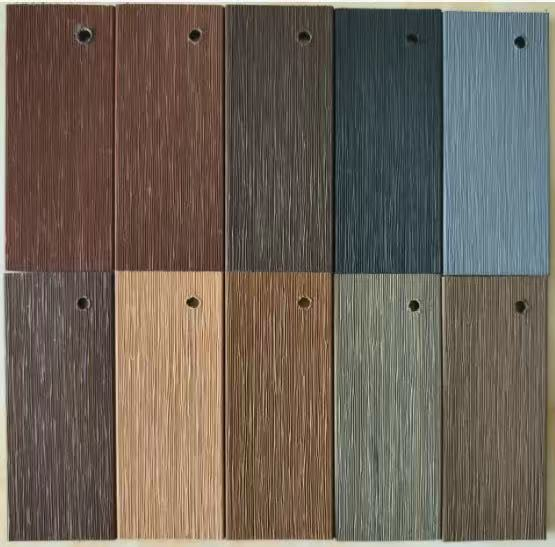
UV Resistance and Color Stability of WPC Decking
ASA Co-Extruded Decks: Industry Benchmark for UV Fading Resistance
Acrylic Styrene Acrylonitrile (ASA) co-extrusion technology represents the gold standard for protecting WPC decking against solar degradation. By encasing the composite core in a UV-resistant polymer layer, ASA shields structural components from photochemical breakdown while preserving color integrity. Unlike uncapped alternatives—many of which show visible fading within 2–3 years—ASA-capped decks retain over 95% of original color saturation after 4,000 hours of accelerated UV exposure. This protective barrier prevents molecular chain scission in both wood fibers and the polymer matrix, significantly reducing surface embrittlement and maintaining flexural strength. The performance stems from integrated UV absorbers and hindered amine light stabilizers (HALS) that neutralize sunlight-generated free radicals.
Accelerated Weathering Tests and ΔE Color Change Metrics for WPC Decking
Industry-standard QUV and Xenon-arc testing quantify WPC performance using ∆E (Delta E) color difference metrics on the CIELAB scale. Premium WPC products maintain ∆E values below 3.0 after 3,000 hours of accelerated exposure—equivalent to more than 10 years of natural weathering—indicating color shifts imperceptible to the human eye. Formulations with titanium dioxide (TiO₂) pigments outperform others by reflecting rather than absorbing UV radiation. Crucially, moisture content during exposure accelerates degradation: samples with water absorption under 0.8% exhibit 40% less color variance than higher-moisture composites. This empirical insight establishes a quantifiable benchmark for long-term aesthetic retention in real-world outdoor environments.
Moisture and Biological Resistance in High-Humidity Environments
Low Water Absorption (<1.5%) and Swelling Control in Tropical and Coastal Climates
WPC decking achieves exceptional moisture resistance—with water absorption consistently below 1.5%, far outperforming traditional wood (10–20%). This engineered low uptake prevents swelling, cupping, and warping in high-humidity tropical and coastal climates where conventional decks deteriorate rapidly. The polymer matrix forms an effective moisture barrier, sustaining dimensional stability through monsoon seasons and salt-laden air. Unlike wood, WPC boards remain dimensionally stable even at sustained humidity levels above 70% RH—critical for regions like Southeast Asia and Florida, where annual average humidity exceeds 80%.
Rot, Mold, and Decay Resistance: How WPC Decking Outperforms Traditional Wood
WPC’s inherent composition resists biological degradation that compromises natural wood decks. Encapsulated wood fibers are inaccessible to mold colonies and fungal hyphae, while the plastic matrix creates an inhospitable environment for rot organisms. Laboratory testing confirms zero measurable decay progression in WPC samples after 36 months of continuous high-humidity exposure—contrasting sharply with pressure-treated lumber, which shows structural compromise within 18 months. This resistance eliminates the need for toxic preservative treatments and addresses the leading cause of deck replacement: biological decay, responsible for 85% of premature failures according to the Forest Products Lab (2023). Homeowners in high-rainfall zones gain decades of maintenance-free service life.
Mechanical Durability Through Real-World Weather Exposure
Real-world weather exposure reveals how WPC decking performs under extended physical stress—beyond what laboratory tests alone can predict. Retention of key mechanical properties is essential when specifying materials for demanding coastal or seasonal climates.
Retention of MOR and MOE After 24-Month Gulf Coast Field Trials
Two-year field trials along the Gulf Coast—the most rigorous real-world test for outdoor decking—show that premium WPC formulations retain over 85% of their initial Modulus of Rupture (MOR) and Modulus of Elasticity (MOE). This strong retention reflects resistance to softening and creep, common failure modes in lesser composites. Performance is driven by advanced coupling agents and thermally stable polymer systems that protect wood fiber–polymer bonds from hydrolysis and thermal degradation. These results confirm that high-density, co-extruded WPC maintains structural load capacity—even after years of direct exposure to intense UV, high humidity, and frequent rainfall.
Freeze-Thaw Cycling Effects on Structural Integrity of WPC Decking
In sub-zero winter climates, freeze-thaw cycling poses a unique risk: trapped moisture expands upon freezing, potentially causing micro-cracking, delamination, or surface spalling. Modern capped WPC mitigates this threat through its co-extruded shell, which limits water absorption to negligible levels—preventing core saturation. As a result, internal stresses from ice expansion are minimized. Independent testing shows that even after 300 freeze-thaw cycles, high-quality WPC retains impact resistance and flexural strength within industry-accepted safety margins, ensuring long-term structural reliability and visual integrity.
Thermal Performance and All-Weather Dimensional Stability
Coefficient of Thermal Expansion: Implications for Gapping and Fastener Design in WPC Decking
The Coefficient of Thermal Expansion (CTE) measures how much a material expands or contracts per degree of temperature change. For WPC decking, CTE typically ranges from 0.4 to 0.6 mm/m·°C—significantly lower than natural wood (often >1.0 mm/m·°C). This lower thermal movement has direct implications for installation and longevity:
- Gapping Requirements: A 3–5 mm gap between boards accommodates summer expansion; insufficient spacing risks buckling under thermal stress.
- Fastener Placement: Edge clips or hidden fasteners must permit lateral movement. Rigid, fixed fasteners restrict expansion and increase the risk of warping or surface deformation.
- Material Advantage: WPC’s inherently lower CTE translates to greater year-round dimensional stability—reducing or eliminating the need for seasonal gapping adjustments required with wood.
FAQ Section
What is ASA co-extrusion technology in WPC decking?
ASA co-extrusion technology involves encasing the composite core of WPC decking in a UV-resistant polymer layer, protecting against solar degradation while maintaining color stability.
How does WPC decking resist weathering and color fading?
WPC decking resists weathering and color fading through the use of UV absorbers, titanium dioxide, and hindered amine light stabilizers, coupled with low moisture absorption rates.
Is WPC decking resistant to mold and decay?
Yes, WPC decking is highly resistant to mold and decay due to its encapsulated wood fibers and plastic matrix, creating an uninhabitable environment for rot organisms.
How durable is WPC decking in extreme climates?
WPC decking is highly durable in extreme climates, maintaining structural integrity through freeze-thaw cycles, high humidity, and temperature variations.
What are the gapping requirements for WPC decking installation?
A 3–5 mm gap between boards is needed to accommodate summer expansion, ensuring year-round dimensional stability without warping or buckling.
